
Brief
Develop a robust, reusable canister to hold medical-grade soda lime for removal of carbon dioxide in closed-circuit breathing systems. The unit must maintain low breathing resistance across a wide flow range, pack consistently to minimise channeling, and enable fast, clean media replacement in clinical settings.
Design highlights
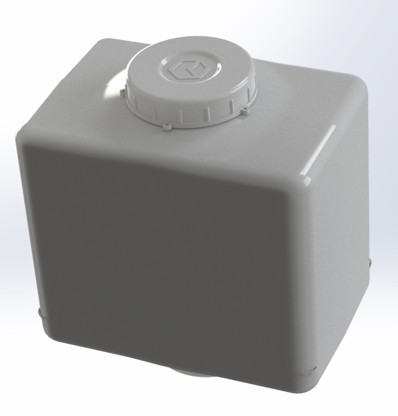
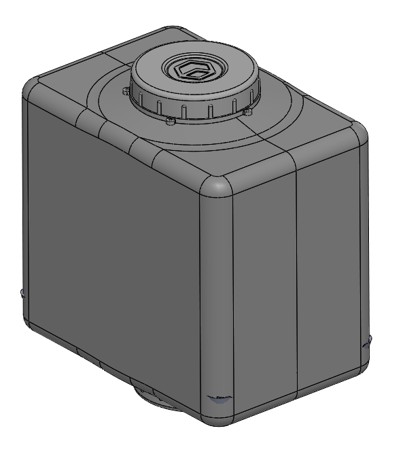
- Blow-moulded shell in PP/HDPE for impact resistance, solvent cleanliness, and lightweight handling; radiused corners and soft geometry aid wipe-down hygiene.
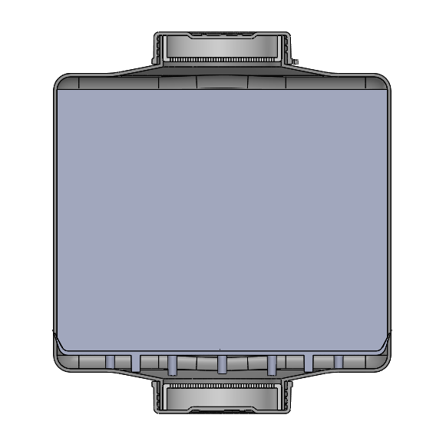
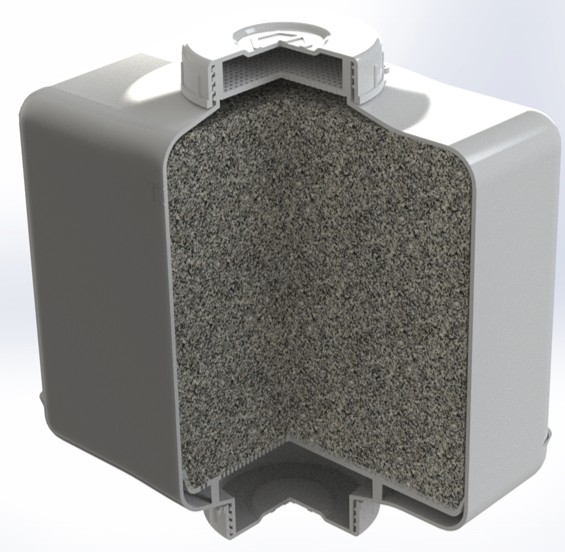
- Inner lattice + flow diffusers spread inspiratory/expiratory streams, controlling face velocity and reducing preferential paths.
- Anti-dust architecture with integrated screens and peripheral seals helps prevent alkaline dust migration to the breathing circuit.
- Tamper-evident cap with quarter-turn bayonet and gasket; fill and empty are guided to keep granules contained.
- Serviceability: large access, smooth internal radii, and optional pre-packed cartridges for quick swaps.
Soda lime media (usage notes)
Designed to accept common medical soda lime granulations (often 4–8 mesh / ~1–5 mm). Proper moisture content and an indicator dye (e.g., ethyl violet types) are typically used by suppliers to signal exhaustion. The canister geometry aims for uniform bed depth and packing density, key to stable absorption and low ΔP.
Performance considerations
- Low pressure drop through wide gas windows, large-radius turns, and tuned perforation area.
- Even utilisation of media bed via diffusers and central chimney concept to mitigate channeling & bypass.
- Cleanability: compatible with common hospital wipe-downs; internal components are smooth and snag-free to avoid dust traps.
Manufacture & materials
- Primary housing: extrusion blow-moulded PP/HDPE, textured exterior (low gloss) for grip.
- Insert components: injection-moulded PP/ABS baffles and cap; silicone or TPE radial seal.
- Screens: sintered PE or stainless mesh, ultrasonically staked to inner lattice.
- Label & lot tracking: recessed pad for laser mark / UDI if required.
Risk & reliability
A DFMEA was run for channeling, dust breakthrough, seal leakage, and incorrect assembly. Mitigations include keyed inserts, poka-yoke cap engagement, captive screens, and go/no-go fit checks. Pressure-drop and leak testing are supported via a simple fixture with quick couplers.
Compliance alignment
Geometry and interfaces are designed to align with typical anaesthesia workstation expectations (e.g., low breathing resistance targets and cleaning practices). Connector geometry and labelling can be adapted to OEM requirements and relevant standards in the final product DHF.